Pattern determination
If you have a golf ball and you want to know which dimple pattern it uses, there are a couple of ways to do it. First of all you can search the golf ball model on the models page. If the ball isn't listed on this site, you can either use the USGA conforming ball lists, or figure out the pattern yourself. Both methods are described below.Using the USGA conforming ball lists
If a ball isn't listed on this website, you can go to my other website (link)
which lets you search through historic USGA conforming
ball list documents. That list contains information on thousands of golf ball models released between 1984-2025.
For each ball, the USGA gives you the number of dimples for each ball, and the manufacturer.
Alas, the dimple count does not give you the actual dimple pattern. For example, I found more than 15 dimple patterns
with 432 dimples! However, given the dimple count and the manufacturer, you can make an educated guess about the pattern.
As an example: let's say you have a Wilson ball, and you found it in the USGA database, with a dimple count of 432.
Now go the models page,
type 'wilson', and browse through
the list of golf ball models and patterns. You will come to the conclusion that it can be one of two patterns: either
ICDD 432, or ICS 432 because (as far as I know) those are
the only patterns Wilson has used with that dimple count. Compare your ball to both of the patterns on this site, and you
should be able to find out which one it is.
If the USGA lists did not lead to success, do read on.
Figuring out the pattern yourself
Figuring out the dimple pattern on a golf ball can be very challenging. I would like to say it's a piece of cake for me, given
my experience of investigating the patterns of more than a thousand golf balls. And although I've gotten much better at it,
it can sometimes still take me longer than I would care to admit.
The steps below work well for determining icosahedral and 6-Part patterns. Other types, like
3-Part patterns and tetrahedrons, can
be more challenging. I will add more information on determining other pattern types later.
STEP 1. Find the seam
Balls with a visible seam are the easiest to determine. If you have located the seam - also called the equator - you also know where both of the poles are. If the pattern is either an icosahedron (the most common pattern type) or a 6-Part pattern, the poles will look something like the images below.
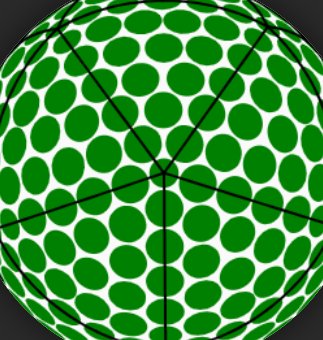
the pole of an icosahedron
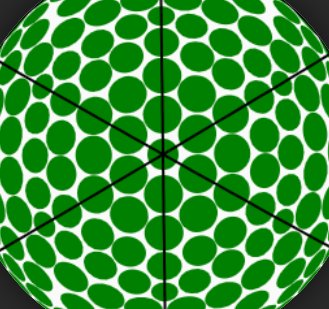
the pole of a 6-Part ball
STEP 2. Count the dimples in one of the hemisphere parts
To determine the number of dimples in the pattern, draw a line from one the petal dimples straight down to the equator.
I use a non-permanent marker for this. Do it with either one of the adjacent petal dimples, and you have singled out
one of the repeating triangular sections of the pattern.
Next, count the dimples N inside the triangle. For convenience, I do not count the pole dimple. That way, N will always be a whole
number, so we don't have to deal with fractions. If you had five petals (icosahedron), the total dimple count
per hemisphere is 5 x N + 1 (the 1 is for the pole dimple). The total dimple count is then 10 x N + 2.
Fun fact: because of the above rule, icosahedral patterns almost always have a total
dimple count ends in 2. You can verify this by checking out the
list of icosahedral dimple patterns.
For 6-Part patterns, the total dimple count is 12 x N + 2.
STEP 3. Compare your pattern
Now that you have determined the pattern type and the number of dimples, it should not be difficult to determine the pattern by comparing it to the patterns on this site. If you found a pattern that is not listed here, please let me know, and I will add it to the database and show it on this site.
Determination by photo
I do not have the luxury of owning every golf ball model (and I'd probably need another room to store 'm in). Luckily, there are
lots of golf ball images available on e-bay. Having multiple images of the same ball is best,
because there's a better chance of them showing both equator and poles. It also depends a lot on the type of pattern:
dodecahedral patterns are relatively easy, because the repeating dimple formations
are visible on every picture, regardless of the ball orientation.
Three-part patterns are a lot harder, because a typical image will not show much symmetry,
as the smallest repeating dimple
formation is about 30 dimples for a typical 3-part pattern. For a dodecahedron, it's about 6 dimples.