About this website
How it all started
I have never played a round of golf in my life. Even so, my house currently contains thousands of golf balls. As is often the
case (or is it?), one hobby has lead to another. I live alongside a canal, and one of my favorite passtimes is going for a boatride in the
neighborhood. Two years ago, I discovered that I could travel a lot further by lifting my kayak out of the water and crossing a road.
Not far beyond the road, the canal passes through a golf course. It did not take long before I noticed the golf balls lying around on the
bottom of the canal.
Before I knew it, I was collecting golf balls. At first, I liked the idea of simply collecting golf ball models. Not much later, I discovered dimple
patterns, and the rest is history. Below is a picture taken from the rowing boat after a rather succesful golf ball collecting session.
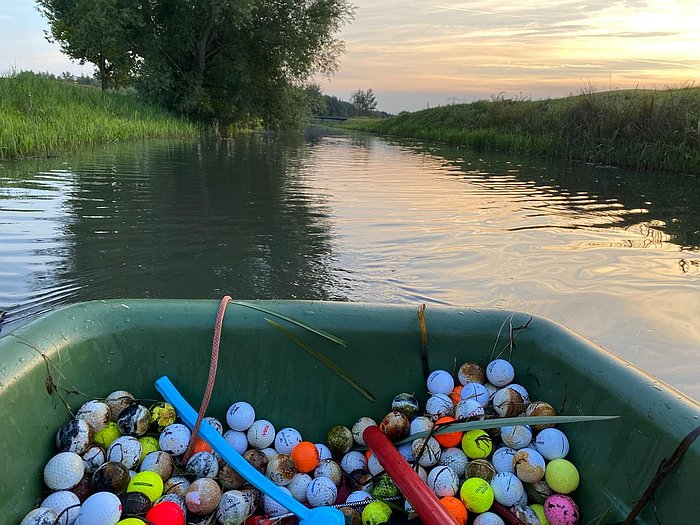
Collecting balls
Over the course of two years, I collected more than a thousand golf balls from a rather short stretch of canal. To collect balls more
effectively, I tried using a variety of tools. Golf balls lying near the side of the canal can easily be retrieved by reaching into the
water but in deeper water, other tools are needed.
Below are some of the tools I used. I started out with the blue 'tennis ball thrower' used by dog owners. That proved suboptimal, often
causing the ball to roll off during the retrieval. Also, it's a bit short. I ended up using the modified badminton racket shown at
the top. The 'net' is made of chicken fencing, fastened using tie-wraps.
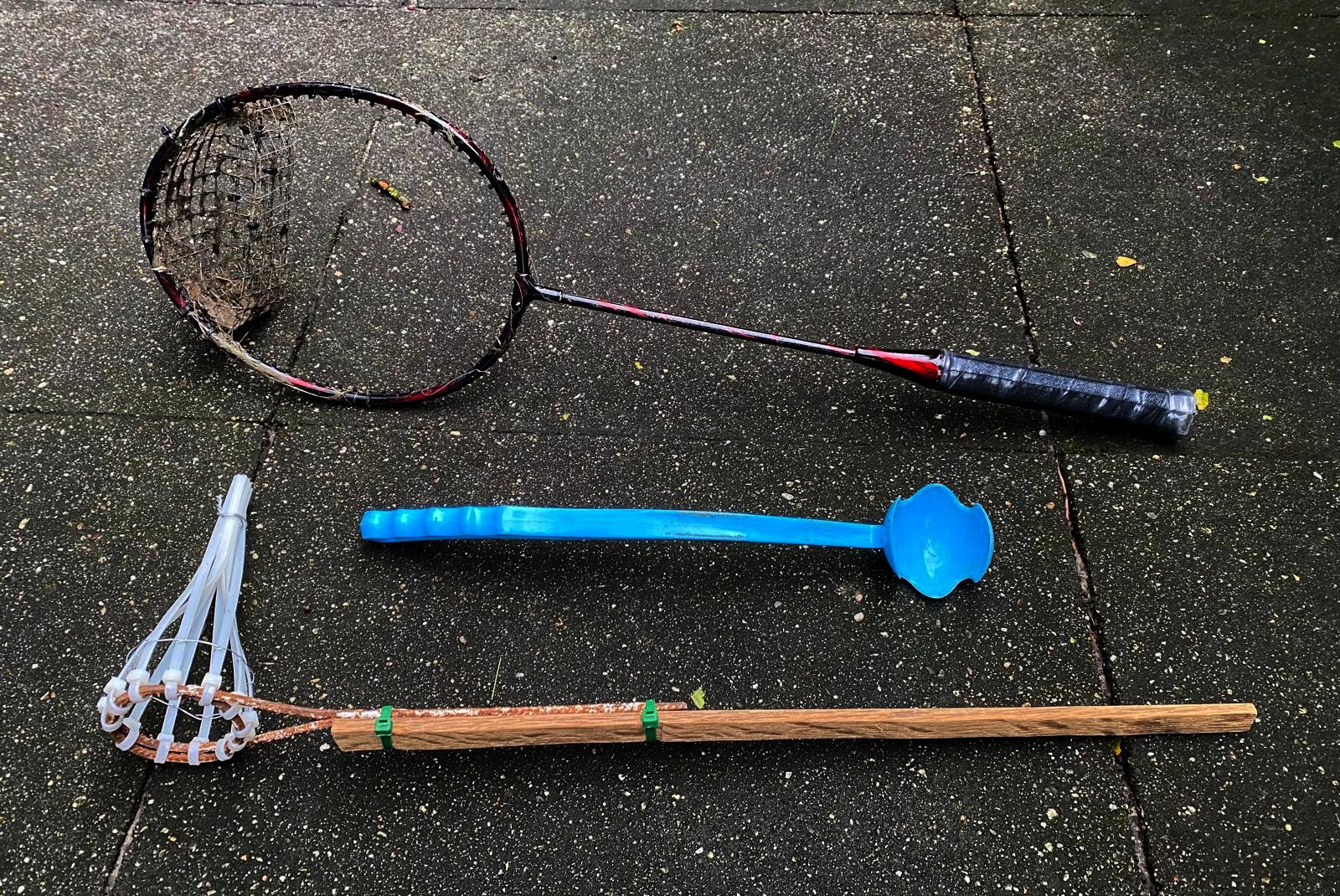
Golf ball retrieval tools
Dimple patterns and symmetry
Designing a golf ball dimple pattern is less time-consuming than a one might think. All dimple patterns make heavy use of symmetry. This
means that only part of the pattern needs to be defined; the rest is a question of smart mirroring and copy-pasting dimples.
Almost all patterns are composed of two identical hemispheres. Furthermore, the hemispheres are divided into smaller identical portions.
For example, an octahedral pattern divides each hemisphere into four identical triangular parts.
It doesn't stop there: each of those parts is symmetric around its midline.
This leaves only half of a quarter of each hemisphere to be defined. For an octahedral golf ball with 400 dimples, only 25 dimples need
to be placed.
An extreme example is the dodecahedral design, where the sphere is composed of twelve pentagons. Each pentagon consists of five identical
triangles. In order to design such a pattern, only one of the triangles needs to be defined. The process is illustrated below for the
DDH 360 Dunlop design, which is featured on many ball models, not only from Dunlop. The design is
nothing more than the relative positioning of six dimples!
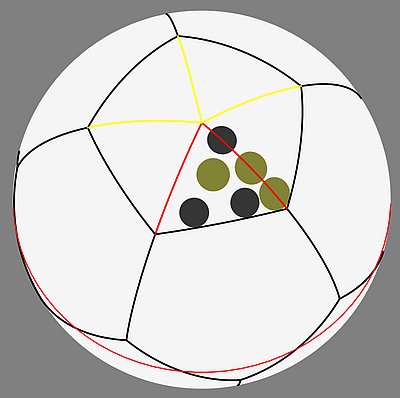
Basic triangle design
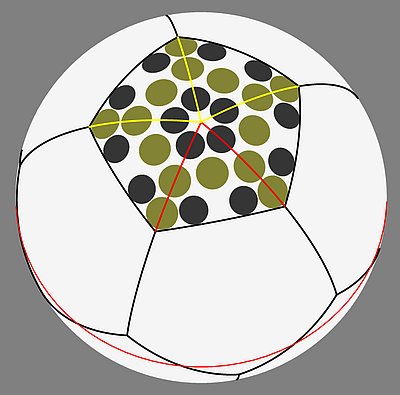
Completed pentagon
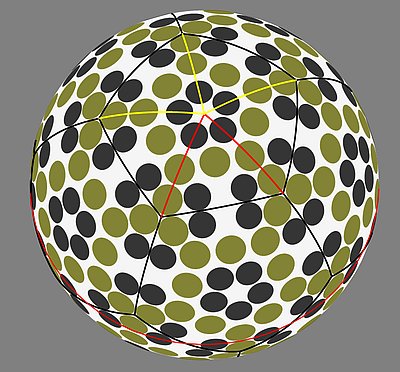
Completed pattern
Pattern Editor
The visualizations of the patterns on this site were made using a pattern editor application I developed specifically for this purpose.
It allows the user to select a pattern category (e.g. icosahedron, dodecahedron, etc.) and place dimples to define the basic design, like
in the above left image. Then, by pressing a button, it applies rotational symmetry to fill the entire pentagon, and copies the pentagon's
dimples to the other pentagons.
I imagine dimple pattern designers use similar tools to design patterns from scratch.
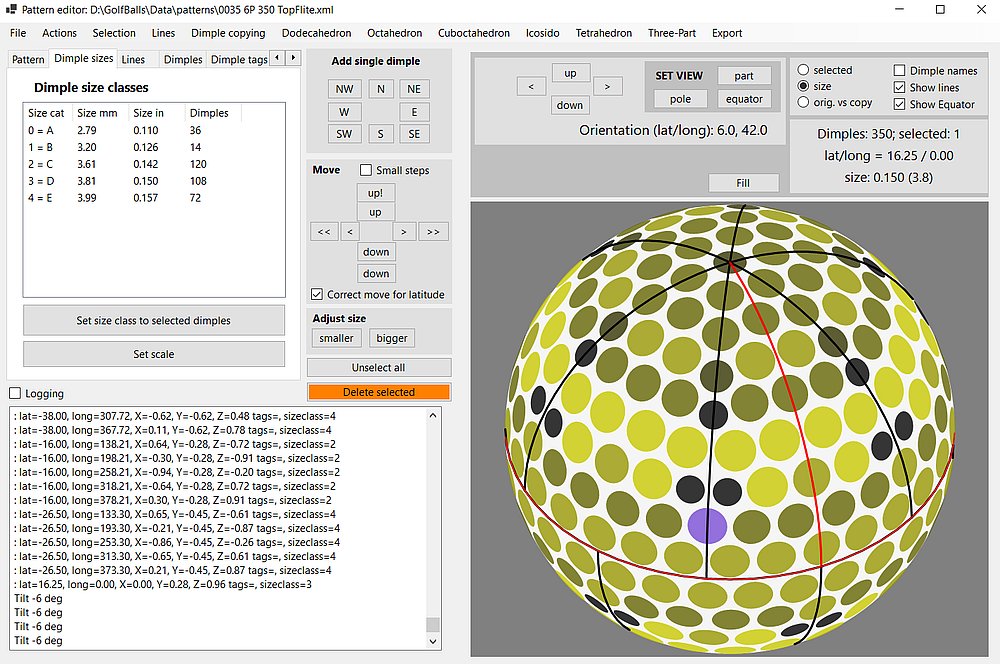
Helpful tools
To accurately reproduce a dimple pattern using the pattern editor, I use a couple of tools. To measure the diameter of dimples, I use a scale lupe (see left image below). It lets you measure the dimple diameter in tenths of millimeters.
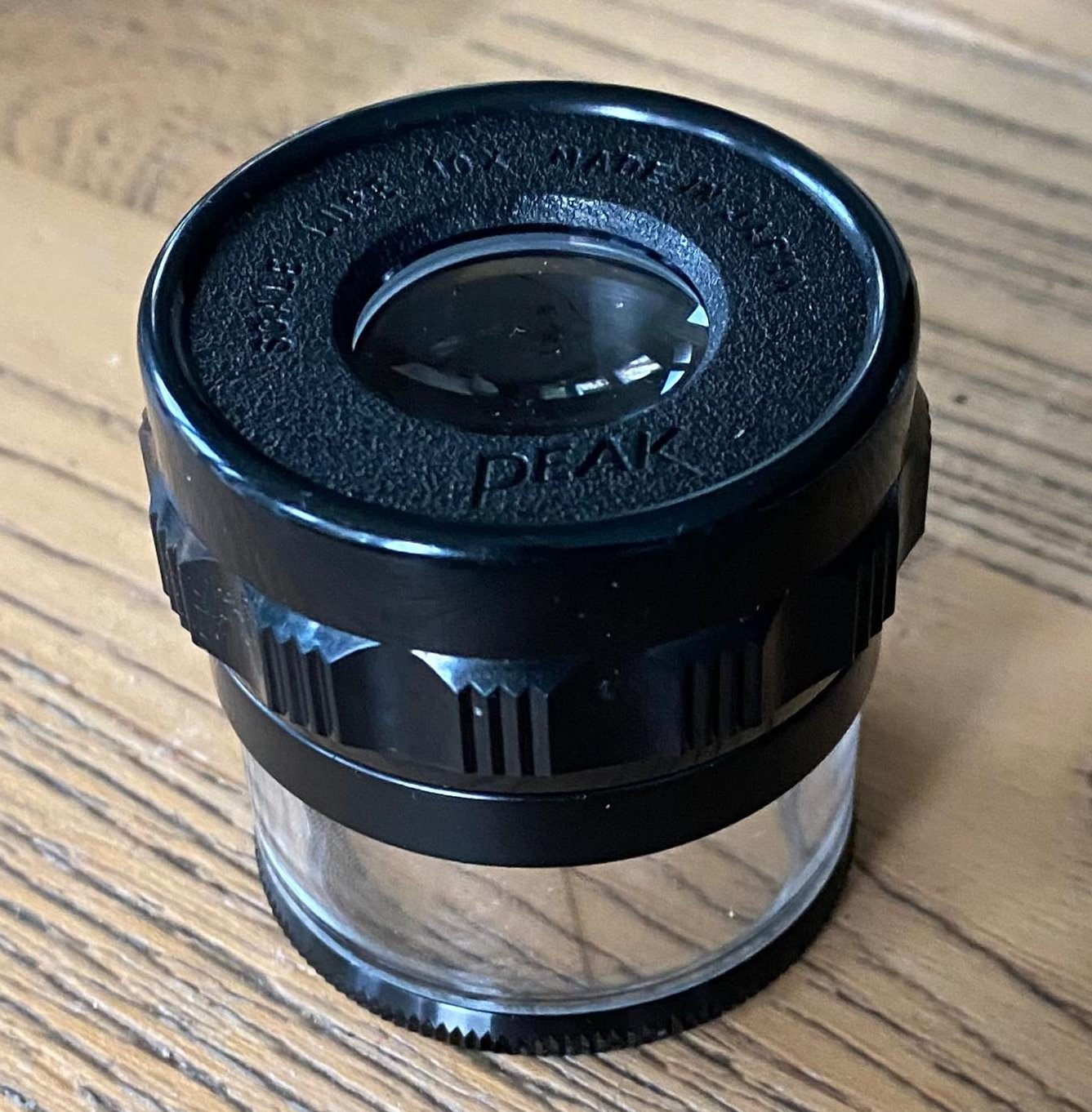
Measuring lupe by Peak
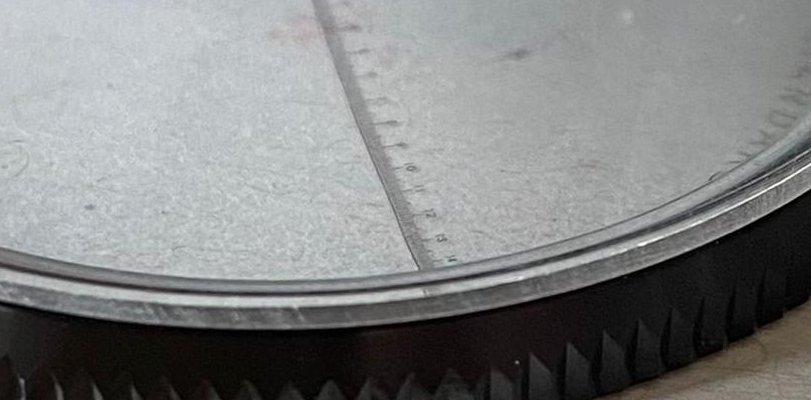
Detail of the lupe, showing the sub-mm scale
To give insight in dimple positions, I made a latitude measurement tool out of a piece of cardboard. Holding it to a golf ball, one can measure a dimple's latitude, i.e. the angular distance from the ball's equator to the dimple.
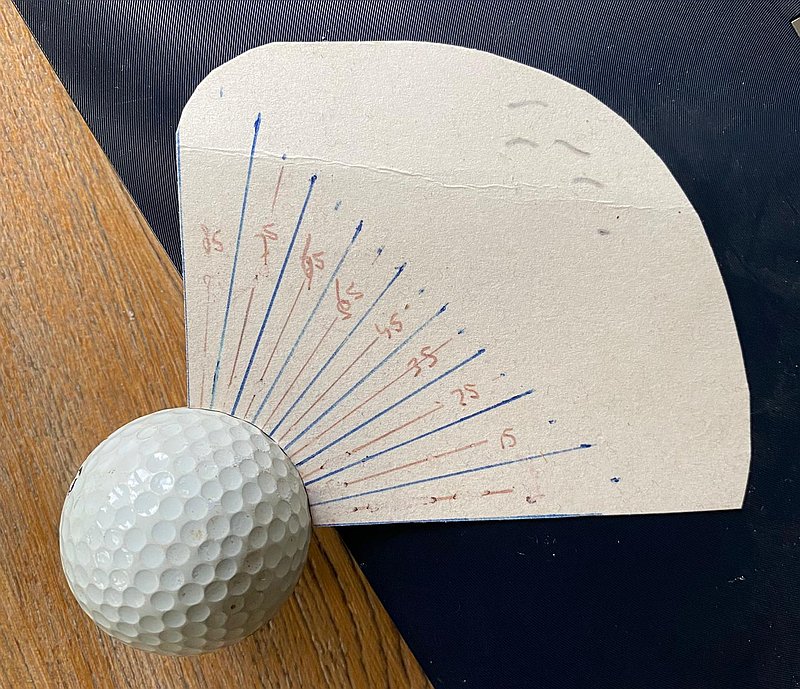
Latitude measurement
The database
To store the list of dimple patterns along with all appropriate properties, I use a database which allows me to quickly retrieve any dimple pattern and look at images to compare it to the pattern on a physical ball. Below is a screenshot of the database manager app.
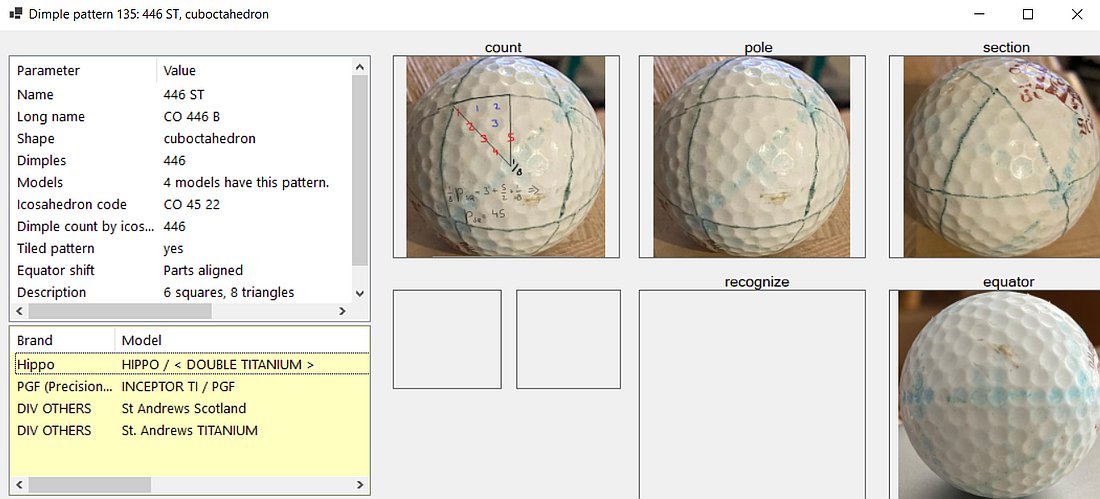
Dimple pattern database application
The USGA conforming golf ball list
The United States Golf Association provides the most valuable on-line resource for the dimple pattern enthusiast. Since 1972, the USGA
has publishes a list of golf balls which are allowed to use in tournaments.
The USGA defines specific rules which balls must follow. One of the rules state that the orientation of golf balls must not affect its flight
behavior. Effectively, this means that dimple patterns should be highly symmetrical.
The conforming list of golf balls is useful, because it gives both the manufacturer and the number of dimples for each golf ball.
Knowing the dimple count isn't enough to determine the pattern, as there are often many patterns for a given number of dimples.
However, manufacturers tend to reuse a small number of dimple patterns, so given both pieces of information one can take a reasonable guess
as to which pattern is used.
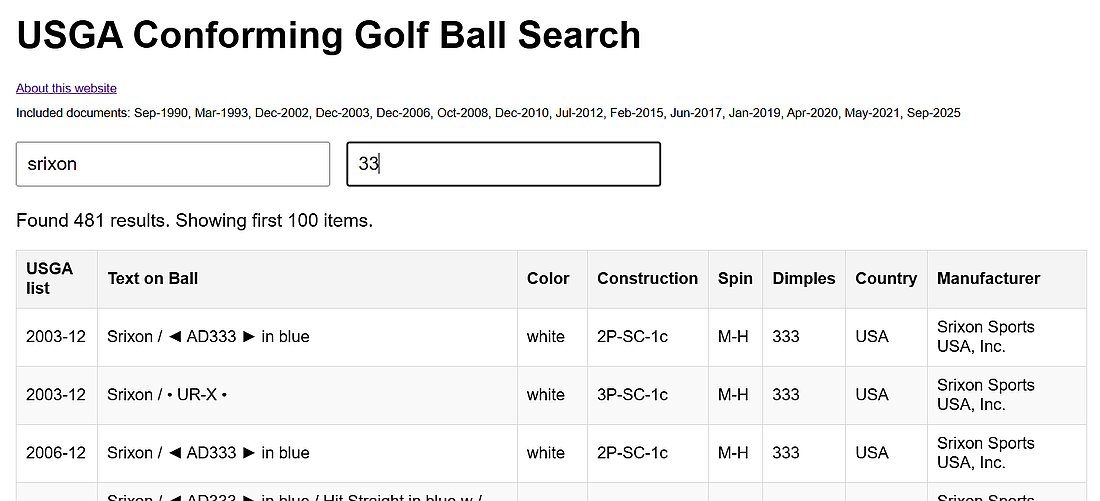
Searching through older USGA lists is rather painful, so I decided to put all available lists in a database. This database may be queried
on my other website: USGA Conforming Golf Ball Search. Below is a screenshot of
the site.
Golf Ball Cover Story
Anyone interested in dimple patterns should take a look at the excellent book Golf Ball Cover Story, by James J. Harrison. As far as I know, it is the only book about dimple patterns. In particular, it describes the patterns used by the Acushnet company, manufacturer of Titleist and Pinnacle balls. There is also a website worth checking out: Golf Ball Cover Story.